

In this new era of Hollywood in which it is common for sequels to be released 10, 20, even 30 or more years after their predecessors, it should be no surprise that Jack Black and (most of) the rest of the gang have returned after a mere eight-year hiatus for Kung Fu Panda 4. Co-directed by Mike Mitchell (The Lego Movie 2: The Second Part) and Stephanie Stine (Storyboard Artist on Raya and the Last Dragon), Kung Fu Panda 4 sees Po (Jack Black) face the challenge of appointing a successor to replace him as the Dragon Warrior, a challenge he promptly ignores in favor of protecting the Valley of Peace from his oldest foe Tai Lung (voiced once again by Ian McShane)… or so he thinks.
Shortly after Po decides to set off on a journey to confront his original adversary, in direct opposition to Master Shifu’s (Two-Time Academy Award Winner Dustin Hoffman) wishes, he receives a tip from an unlikely source that sends his path in an entirely new direction. Newcomer Awkwafina’s character, Zhen, having recently been detained after attempting to rob the Jade Palace, informs Po that his real target may not be Tai Lung at all but, rather, a sinister, shapeshifting sorceress known as The Chameleon (voiced by EGOT Winner Viola Davis). According to Zhen (Awkwafina), The Chameleon plans to gain access to the spirit realm, free all of the evil Kung Fu Masters (many of whom Po helped banish to the spirit realm to begin with), and acquire their Kung Fu skills for her nefarious purposes.

As is typical of this series, the plot of Kung Fu Panda 4 relies heavily on age-old storytelling tropes to guide the audience through another predictable romp in the realm of the Dragon Warrior. And, though this story includes many new locations, aesthetics, and characters, the plot leaves little to the imagination with unexpected twists and turns between few and none.
That said, consistently predictable storytelling has never inhibited this franchise in the past, as it has always thrived on the appeal of its characters. As mentioned, this fourth installment in the Kung Fu Panda franchise features many familiar faces including Hoffman’s Master Shifu and McShane’s Tai Lung, as well as Po’s Dads, Li and Mr. Ping, voiced by Bryan Cranston and James Hong, respectively. And, in addition to newcomers Davis and Awkwafina, newly-minted Academy Award Winner Ke Huy Quan and standup comedian Ronny Chieng appear as first-time inductees into the Kung Fu Panda universe.
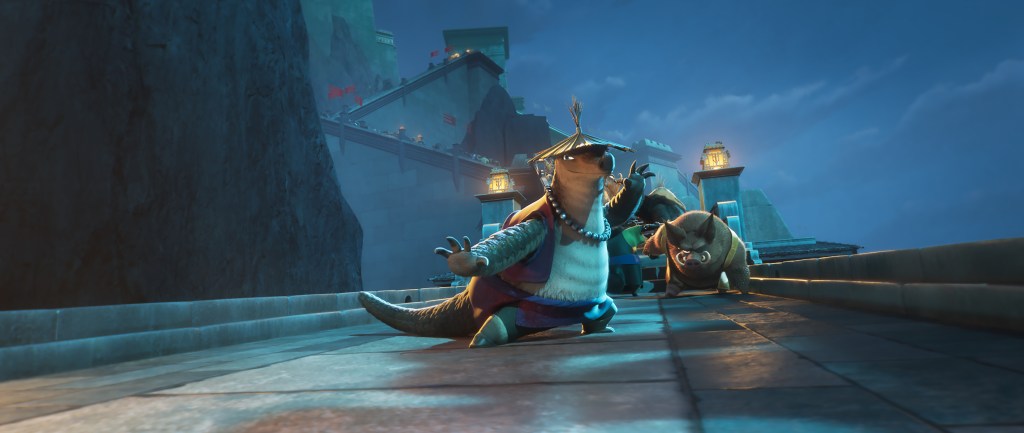
Altogether, this cast mostly makes up for the noticeable exclusion of some of the franchise’s most beloved characters. This is due in large part to Viola Davis’ creepy and cunning Chameleon, the best villain of the series so far, which is saying something considering the Kung Fu Panda films have always had strong villains like Gary Oldman’s Lord Shen and J.K. Simmons General Kai in addition to the aforementioned Tai Lung. Additionally, the hilarious and heart-warming antics provided by Bryan Cranston’s Li and James Hong’s Mr. Ping provide the effortless fun we’ve come to expect from this series since its debut in 2008.
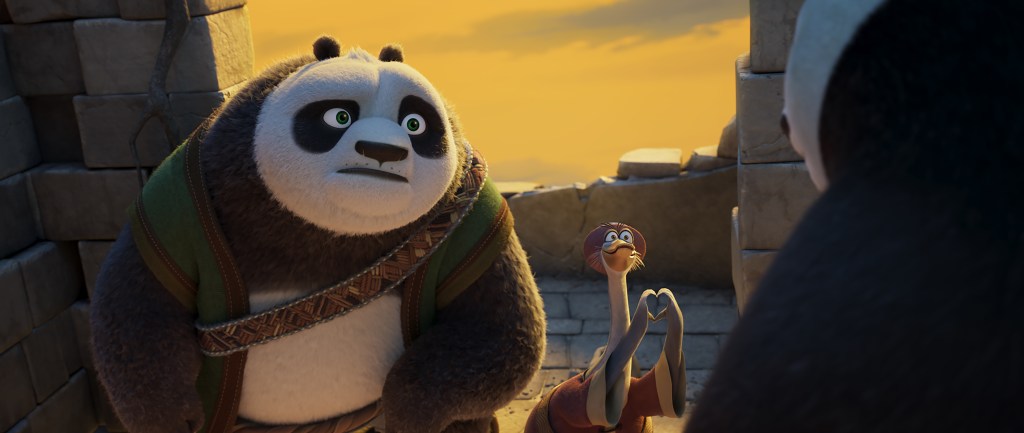
Conversely (and unfortunately), Awkwafina’s sly fox character Zhen fails to establish herself as a worthy counterpart and step out of the shadow cast by Jack Black’s iconic Po, and that is coming from a stalwart defender of Awkwafina who is an excellent actor and comedian. The writing, in this case, is the real culprit as it fails to take advantage of Awkwafina’s comedic chops and deliver anything truly unique with which she can define herself. It is a relatively small issue for the film but one that will leave fans yearning for the dynamics of Po’s prior crime-fighting companions.

Compelling characters, however, are only one of the ingredients in the formula that’s made Kung Fu Panda one of the most commercially successful animated series of all time. The other most important ingredient has always been the films’ visual appeal. And, in this regard, Kung Fu Panda 4 stands above the rest. Sure, it should be expected that after eight years of technological advancements Kung Fu Panda 4 would have a virtual leg up on its predecessors, but that doesn’t make the effect any less impactful. From the sweeping, large-scale cityscape of Juniper City to the 2D hand-drawn appearance during flashbacks (a recurring tool in the series), Po’s world has never looked as vibrant as it does in this latest movie.

Beyond the general aesthetic of the movie, Kung Fu Panda 4 takes a massive leap forward in the visual direction of the film’s many combat and chase sequences with the help of a new technological advancement the animation team has quaintly referred to as the “Go-Po Camera.” This virtual “camera” allows the animators to show more dynamic perspectives including zooming in Po’s face as he squeezes through tight gaps in midair and mirroring the movements of his body within a fight sequence as he dips and dodges incoming enemy attacks. While these new elements of the camera work within the film may be subtle, they make enormous enhancements to the immersiveness of the film and the engagement of the audience throughout each action setpiece.
In all, Kung Fu Panda 4 is a pleasant return to the Valley of Peace and the world of the Dragon Warrior. Though some of its character and story choices keep this film from reaching the highest levels of the series so far, fans who loved the first three movies will leave satisfied with this entry in the franchise and clamoring for more fun kung fu adventures as soon as Dreamworks wants to provide them.
Skadoosh!
7.1 out of 10 Kernels
-Cam


 POPCORN FOR BREAKFAST
Leave a comment