
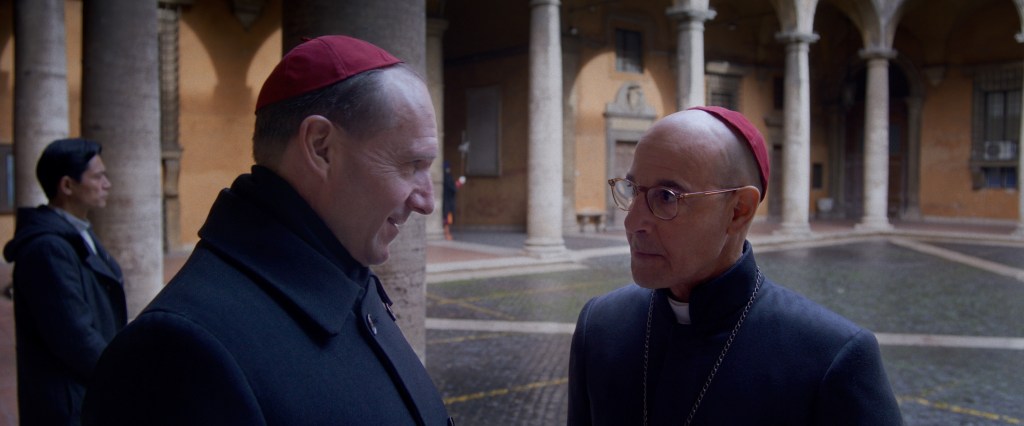
Movie: Conclave (2024)
Production Companies: FilmNation Entertainment, House Productions
Distributed by: Focus Features
Producers: Tessa Ross, Juliette Howell, Michael Jackman, Alice Dawson, Robert Harris
Directed by: Edward Berger
Written by: Peter Straughan
Based on: Conclave by Robert Harris
Starring: Ralph Fiennes, Stanley Tucci, John Lithgow, Isabella Rossellini, Sergio Castellitto
Review by: Cam Wiggs
I always get excited when the presidential election rolls around every four years. And no, it is not because I derive sadistic pleasure from being inundated with political ads every 15 seconds or because I am a starry-eyed romantic who believes my chosen candidate will make all my wildest dreams a reality sometime in the next 4 years. No, the reason I get excited every election season is much simpler (read: dumber): I love political thrillers.
It is a niche genre but you’d be hard-pressed to find a genre with a higher percentage of iconic films than political thrillers. From one of my all-time favorite movies, 1974’s The Parallex View, to more contemporary instant classics like Zero Dark Thirty and Argo (both of which released in 2012) the genre is, pound-for-pound, as strong as any other. And, though the genre is certainly niche as I said earlier, it is also , counterintuitively, broad in its scope. Take the three films I mentioned earlier for instance. Their plots revolve around three very different stories: a deep-state government conspiracy, the hunt for a notorious war criminal, and a complex hostage crisis with global stakes.
Despite the breadth of incredible options within the political thriller genre, however, during election season, I like to narrow my rewatches to films that revolve around an election. The movie playing in the background as I type this review is a perfect example: George Clooney’s The Ides of March (2011). This movie has become a staple for me each of the last three presidential elections since its release. With a uber-talented cast including George Clooney, Ryan Gosling, Paul Giamatti, Philip Seymour Hoffman, and Evan Rachel Wood and a razor-sharp script penned by House of Cards showrunner Beau Willimon, I find that The Ides of March is like a theragun to help release all the election tension this time of year.
So, imagine my surprise when I walked into the theater earlier this week fully-expecting a slow, thoughtful drama about the Catholic Church and instead got served a gripping, unrelenting political thriller that scratches that same election season itch as The Ides of March. The film responsible for this pleasantly surprising bait-and-switch is Conclave (2024) and it is the subject of my review today.
Directed by Academy Award Nominee Edward Berger and starring three Academy Award nominees, Ralph Fiennes, Stanley Tucci, and John Lithgow, in addition to Isabella Rossellini and others, Conclave, based on a 2016 Robert Morris novel of the same name, tells a modern, fictional story about the convening of the cardinals to elect a new pope. In the story, Cardinal Lawrence (Fiennes), Dean of the College of Cardinals, finds himself in the position of organizing and managing the papal conclave following the unexpected death of a beloved pope. While there is no foul play presumed surrounding the death of the pope, Cardinal Lawrence quickly discovers that the selection process will be far from straightforward due to new rumors and circumstances surrounding the cadre cardinal candidates.
Now, based on that description, you are probably feeling like I did walking into the movie. I mean, sure, it sounds okay but there is nothing there to spark more than casual interest, right? To answer that question, allow me to reintroduce you to Mr. Edward Berger.
The director of Conclave, Edward Berger, is a German writer-director who you will remember as the writer and director of 4-time Academy Award winning film All Quiet on the Western Front (2022), the same film for which Berger received his first (and currently only) Academy Award nomination (Adapted Screenplay). And, for those who have seen the aforementioned film, many of the creative decisions that were widely-praised by critics and audiences alike are also on full display in Conclave: extreme attention to detail, gorgeous cinematography, and an instantly iconic score to name a few. But, you’ll be pleased to hear there’s even more Berger brings to the table in his first English language feature film.
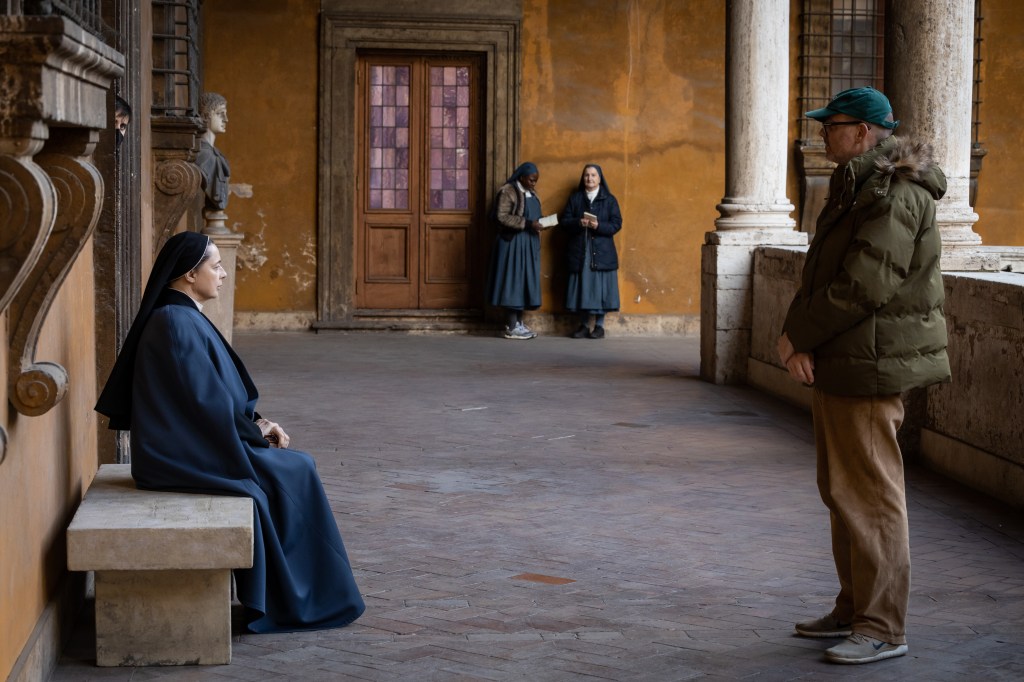
For starters, Edward Berger wastes no time letting audiences know they are not in for a typical cinematic romp around the Vatican. It starts with scene one. The pope is dead. The cardinals are assembling. The framing is claustrophobic and tense, the score anxious and staccato, the details sharp and lingering, and, just like that, Edward Berger has us all leaning forward in our chairs. It’s a symphony of perfectly polished cinematic beats that come together into one of the most gripping openings I’ve seen from a film this year.
Having gained the attention of the audience, Berger’s job now is to keep it, something easier said than done with a religious drama. Luckily, Berger has help. The screenplay for the film was written by fellow Adapted Screenplay Academy Award Nominee Peter Straughan, the writer of another one of my favorite political thrillers of all time, Tinker Tailer Soldier Spy (2011) (the same film for which he was nominated). Together, Straughan and Berger take a thoughtful, disciplined approach to adapting Robert Morris’ novel to the silver screen, never bogging it down with too much dialogue or overcomplicating the narrative. Being a fictional tale based in the realm of reality, it can be a considerable challenge to maintain the suspension of disbelief among the audience. This is infinitely more challenging when the subject matter revolves around the Catholic Church, a subject on which almost every single person in the audience, regardless of their background, will have a strong opinion. Despite those obstacles, Berger and Straughan maintain the audience’s attention and suspension of disbelief in many ways.
The first way is their masterful handling of the sensitive subject matter that is the Vatican and the Catholic Church. Rather than taking a hard stance in one direction or another, Berger instead opts for a demystification of the Catholic Church. The film never directly passes judgment on the Church itself through its theming or narrative, instead choosing to lay bare the papal election process the best it can without the cooperation of the Vatican and leaving the final judgment to the viewer. But that doesn’t mean Berger shies away from any controversies, realities, or rumors about the Catholic Church. The movie boldly highlights those past and present situations and issues as a means to assist the audience’s evaluation process. But, in choosing not to put forth an opinion on the church, Berger keeps the audience from making snap judgments based on any preconceived notions they had heading into the film which could have caused them to check out completely. It’s a surprising but effective choice and a testament to Berger and Straughan’s discernment as a director and writer respectively.
Another way in which Berger and team maintain the attention of the audience is through the clinical execution of a time-honored narrative tool: Chekhov’s Gun. It’s truly remarkable how often this bulletproof (see what I did there?) principle is mishandled in modern films. Whether it is introducing plot elements that have no purpose whatsoever or overusing plot elements in such a ham-fisted way that you introduce too much predictability, misuse of the Chekhov’s Gun principle is rampant in the cinema of today. But don’t ever accuse Edward Berger of that same misuse. Throughout the setup and into the second act of the film, Berger highlights a number different plot elements that play various roles of major or minor importance as the film progresses. The genius behind this is that the plot elements are disparate and spaced perfectly such that even if you make a conscious point of remembering a certain element, the shell game being played with the narrative is effective enough to get you to drop your guard just in time for the payoff. I truly cannot remember the last time I saw the Chekhov’s Gun principle used so effectively. It significantly enhances the effectiveness of the film. The obvious caveat here is that the film is adapted from a book. So, it is possible all those plot elements were lifted from the book’s original narrative. Even so, the adaptation of those elements to the film medium is impressive on its own merit.
The final and most critical tool Berger and Straughan have in their arsenal to keep the audience’s attention and suspension of disbelief in tact is the cast. With a movie like this, regardless of how tight the screenplay is or how precise the creative vision is, it all goes down in flames if you don’t have an all-star cast in tow to execute. In this department, Conclave is far from lacking. The lead actor in the ensemble, Ralph Fiennes, has an interesting task, similar to that of a narrator in a novel (for reference, Fiennes’ character is not the narrator in the book) wherein the audience is learning every new bit of information at the same time as him. As such, his reactions are key to the successful execution of the story. It sounds dramatic, but it really is not an overstatement to say if he over or underplays a particular reaction to a bit of information or personal revelation, it can ruin the effect of the story.
As an added layer of complexity, his character, unlike a typical narrator, is multi-dimensional and imperfect. Luckily for all involved and as you probably guessed by now, Ralph Fiennes does not miss. On the contrary, he turns in one of the most affecting and impressive performances of his entire career, one already teeming with excellent performances. The rest of the cast is fantastic as well, fulfilling the murder mystery suspect-esque nature of their roles with expert precision and commitment, but its Fiennes who takes the film to heights it simply would not reach on its own.

In the end, Conclave isn’t just a interesting drama in spite of its seemingly bland subject matter. It goes far beyond what I could have ever imagined to deliver something sharp, exhilarating, thought-provoking, and unforgettable. Thanks to Berger’s guidance, Straughan’s pitch-perfect screenplay, and an iconic ensemble performance, Conclave successfully demystifies the papal election process, uses Chekhov’s Gun to maximum effectiveness, and turns in an Academy Award worthy political thriller for your election season viewing.
9.3 out of 10 Kernels
Thanks for reading!
-Cam

 POPCORN FOR BREAKFAST
Leave a comment