

Movie: Nickel Boys (2024)
Production Companies: Orion Pictures, Plan B Entertainment, Louveture Films, Anonymous Content
Distributed by: Amazon MGM Studios
Producers: Dede Gardner, Jeremy Kleiner, David Levine, Joslyn Barnes
Directed by: RaMell Ross
Written by: RaMell Ross, Joslyn Barnes (screenplay), Colson Whitehead (novel)
Starring: Ethan Herisse, Brandon Wilson, Hamish Linklater, Fred Hechinger, Daveed Diggs, Aunjanue Ellis-Taylor
Review by: Stefano Todaro
It’s rare to watch a film that gives its protagonists full ownership of the story being told. It’s even rarer to see this done for a film set in the Jim Crow era of the United States. Yes, most films have a point-of-view, and yes, most films have a perspective, but Nickel Boys tells its story only from the first-person perspective of its main characters, Elwood and Turner. Director RaMell Ross undoubtedly took a huge risk. Having a film entirely in a first-person format runs the risk of ostracizing viewers who prefer a more straightforward form of storytelling, as well as those viewers who see this decision as just a gimmick. I can assure you that not only is this not a gimmick, but it’s also an undeniably stunning way to bring Colson Whitehead’s Pulitzer Prize-winning novel, The Nickel Boys, to life.
Because of the decision to film in the first-person, Elwood, played primarily by Ethan Herisse, and Turner, played primarily by Brand Wilson, are able to tell us their truths without anybody getting in the way to distort them. Countless films set in this period do their best to gloss over particularly difficult hardships and truths, leaving viewers with saccharine views of one of the most shameful times in America. To make those troubling themes even easier to swallow for a wide American audience, we see far too many examples of white savior film mechanics. Thank goodness for Viggo Mortensen in Green Book; we’d still be a racist country if it wasn’t for his character. And thank goodness this film and source material never fell into that trap.
Except for inter-spliced bits of historical video, the entirety of the Nickel Boys story progresses only from the experiences of our two protagonists. The story starts with Elwood as a young child and goes all the way through to nearly the present day. Elwood is at the wrong place at the wrong time and is accused of a crime he didn’t commit. To pay for his “crimes,” he is forced to attend a reform school, Nickel Academy, in Florida. This is where he meets Turner. Elwood hasn’t seen a place like this before, at least nothing that we’ve seen from his eyes yet. The campus is unnervingly pretty when Elwood is driven in. He glances around at beautiful mansions and buildings and the greenest trees he’s ever seen. Maybe this won’t be as bad as it seemed initially, but his eyes are failing him as he will quickly find out. Elwood is in the car with white teenagers and they are seemingly all going to the same place. Those boys then get dropped off separately at one of the more impressive buildings while he is told to stay in the car to join the other black kids elsewhere.
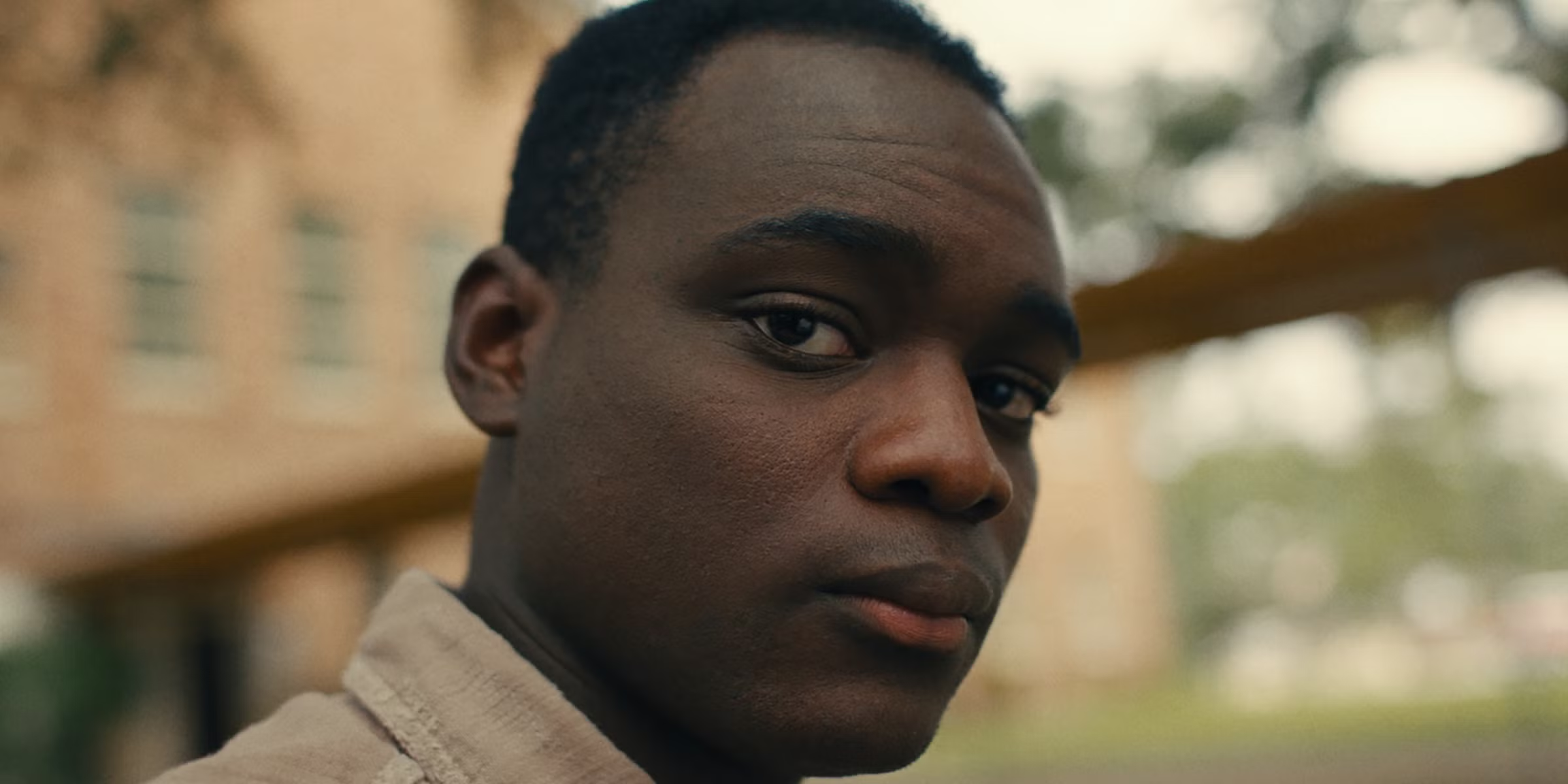
It’s evident that these kids were raised similarly, raised in a way that made them all believe that they needed to look out for themselves first. Looking out for oneself wasn’t taught as being selfish but rather as a survival mechanism to outlast the 50s and 60s in America. Elwood naively thought he was going to be somewhere where he and others would bond over shared experiences, but it’s clear he was in an “every man for himself” environment. Turner is the only other person who takes an interest in Elwood, mainly because he can tell Elwood is a little different and wants to see why. The two quickly become closely acquainted and become each other’s lifelines. They can only trust each other (and maybe just a few of the others).
To not entirely hide Elwood’s face from the viewers, it’s at this time where the first-person perspective begins to go back and forth between Elwood and Turner, sometimes to the point of confusion. At times, it can be unclear for just a second who eyes we’re looking out of, but that’s part of the beauty of Nickel Boys, as the lives of these two slowly become somewhat interchangeable. To the people who run Nickel Academy, aren’t all of the kids there interchangeable? Dispensable even? More atrocities get uncovered. The white boys can unwind and play football, while the black ones are beaten, sometimes to death, if they become unruly. Those victims ended up being reported as runaways.
In a film with such vivid and stunning imagery, it’s breathtaking that you can also feel the weight of the sorrow on your chest. Nickel Boys is unashamedly proud of its perspective, and the viewer can do what it wants with the result. The performances from Herisse and Wilson are outstanding, and Aunjanue Ellis Taylor’s turn as Elwood’s grandma is beautiful. Don’t be fooled into thinking the cinematography and filmmaking techniques are a ploy to get you to watch something you’ve already seen before; you’ll be sorely missing out if you skip Nickel Boys.
9.3/10
By: Stefano Todaro


 POPCORN FOR BREAKFAST
Leave a comment