
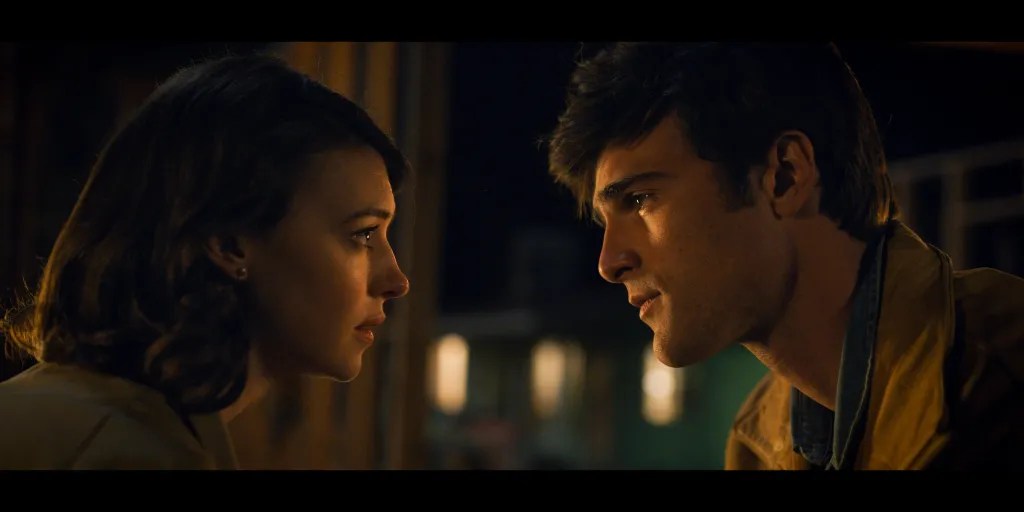
Movie: On Swift Horses (2024)
Production Companies: Ley Line Entertainment, FirstGen Content, Cor Cordium, Wavelength
Distributed by: Sony Pictures Classics
Producers: Peter Spears, Daniel Minahan, Tim Headington, Mollye Asher, Theresa Steele Page, Michael D’Alto
Directed by: Daniel Minahan
Written by: Bryce Kass
Starring: Daisy Edgar-Jones, Jacob Elordi, Will Poulter, Diego Calva, Sasha Calle
Review by: Cam Wiggs
Going in blind. This revered film-watching strategy, by which many cinephiles swear, grows rarer by the day in this age of breaking news alerts, podcasts, and algorithmically-calibrated social media feeds. Still, some purists go to extraordinary lengths to avoid knowing what they are walking into when they enter a theater. They deny themselves even a glimpse of a trailer, poster, or, god forbid, a review prior to their viewing and assure anyone who will listen this is the best possible way to experience a film. It’s an admirable approach, despite the debatability of its impact on the viewing experience.
For someone like me – a film-industry junkie with gobs of movie-centric Twitter accounts on notifications – “going in blind” is just short of impossible, except in the unwonted occurrence a film eludes my gaze from announcement all the way through production. Generally, I know something about every movie I watch. So, when I received an invite to a screening of On Swift Horses, I couldn’t help but re-read the title a few times in confusion. How did this film, based on a recent novel of the same name and featuring a cast list teeming with swoon-worthy Hollywood up-and-comers, completely fail to come to my attention at any point over the last two years? I still don’t have an answer to that question. Nonetheless, I relished the opportunity to watch a movie with my mind completely free of pre-conceived notions.
On Swift Horses can best is best categorized as historical fiction and romantic drama. Set in the mid-50s United States, the story begins with a young couple, Muriel (played by Daisy Edgar-Jones) and Lee (played by Will Poulter), awaiting the return of Lee’s brother, Julius (played by Jacob Elordi), just back from the Korean War. Upon Julius’ arrival, Lee and Muriel plan to leave Muriel’s deceased mother’s Kansas homestead and head to California with Julius in pursuit of the American dream. Once Julius arrives, however, it quickly becomes clear that this dream is not shared by the three of them. In fact, it’s only Lee’s dream. Julius’ free-spirited, unconventional nature awakens something from deep within Muriel, setting in motion a trio of distinct paths (if not physically then certainly emotionally) for each of them as Lee and Muriel continue with their move west without Julius.
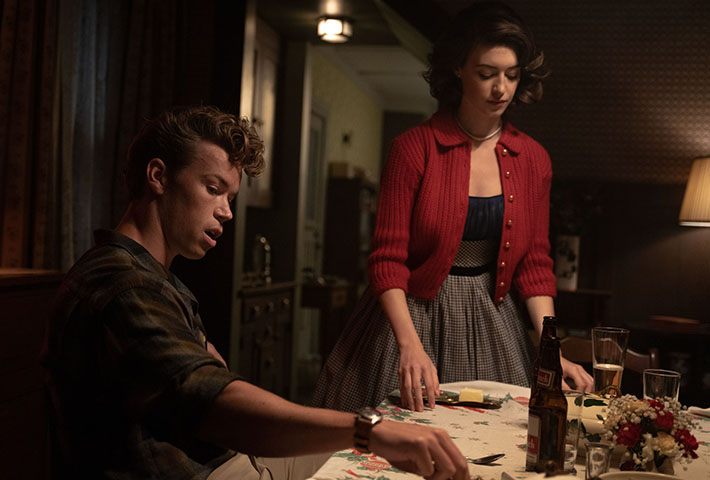
Now, if that story background sounds like the setup for a romance novel, that’s because (as I mentioned earlier) it is! And, though I had no prior knowledge of this novel’s existence, I was able to identify this movie as an adaptation of an existing work within a few minutes. To be clear… that’s not a good thing.
One of my core beliefs as a lover of film (and, more generally, art) is that you should only adapt an existing story into a film if there is something positive the film medium can provide that the existing medium could not. It may seem like a broad rule but you’d be surprised. I have seen this rule broken more often than not in adaptations I’ve watched. Unfortunately, On Swift Horses is another rule-breaker to add to this list. Even having not read the original work, I can tell you there is nothing done in this movie that could not have been done adequately or even better as a written work. I’d also hazard a guess that many aspects of the film adaptation are executed more poorly than the book.
The aspect of the film where I feel this is most apparent is the dialogue. Now, I’ll be the first to acknowledge that good dialogue is hard to come by. Even great films struggle with dialogue here and there. As any writer will tell you, dialogue is the hardest thing to write. That said, if you are adapting a novel to film, you should have a leg up in the dialogue department as the source material is already chock-full of it and some of it has to be good (otherwise, why bother making a movie). In this area, On Swift Horses almost certainly delivers a worse product on screen than in the book. Throughout the film, many very capable actors deliver uneven performances simply because the lines they are reading lack proper flow, authenticity, and emotional weight. And this dialogue discrepancy is exposed even more clearly by the sporadic character narration used in between scenes or over montages that is beautifully articulated and obviously taken verbatim from the source text.
Also, though I did previously give some performances a pass in this film based on the dialogue issues I mentioned before, there are other performers who struggle for reasons beyond the dialogue. The two cast members who seemed to have the hardest time in this film are Daisy-Edgar Jones and Jacob Elordi. As Muriel, Edgar-Jones never quite settles in on exactly what her character is about despite receiving the majority of the screentime to flesh it out. And since her scenes are usually immediately followed and/or preceded by Julius’ scenes, it creates a really bumpy dynamic with her performance where you don’t know which version of Muriel you are going to get the next time the story turns its attention back to her.
Regarding Elordi’s Julius, there is simply a lack of authenticity. He seems to focus so much of his energy into creating an image (with the slow cigarette drags and long pensive looks into the void), that he fails to create a character. Nothing about Julius feels real, particularly against the backdrop of mid-century America. This disparity of genuineness is especially evident in the scenes he shares with Diego Calva, who seems to effortlessly develop his character (Henry) despite having less with which to work.

Beyond the dialogue and the performances, the filmmakers (Director Daniel Minahan and Writer Bryce Kass) lacked the confidence to imbue this film with any sort of consistent creative vision. Whether it’s a product of this being only the second feature film for each of our key creatives or an overall apathy toward the source material, I will avoid speculation. Still, it is not clear at any point what exactly they were trying to deliver in adapting this novel into a film. Instead, it feels like a half-hearted attempt to recreate the book in film form rather than taking the time and effort to truly adapt it for the screen.
Despite those harsh criticisms there are a few aspects of the movie I thought worked well and the cinematography is undeniably one of them. Shot by veteran cinematographer Luc Montpellier, On Swift Horses showcases a beautifully romantic look at Kansas, Las Vegas, and Southern California in the 1950s. Even at times in the film where I thought the production or lighting design was questionable, the subsequent shots provided in those set pieces were always thoughtful and interesting. This a movie that is easy on the eyes and not just because it over-indexes in the attractiveness of its cast.
Also, while the story issues go even farther than just the dialogue and lack of creative vision, the film does end in a place that helps resolve much of the thematic murkiness of the first two acts. That’s not to say the issues are fully reconciled by the end of the film and, admittedly, I do think the clarity of the ending is more of a factor of the strength of the source material than anything else, I do give the filmmakers credit for resolving the plot in a satisfying place.
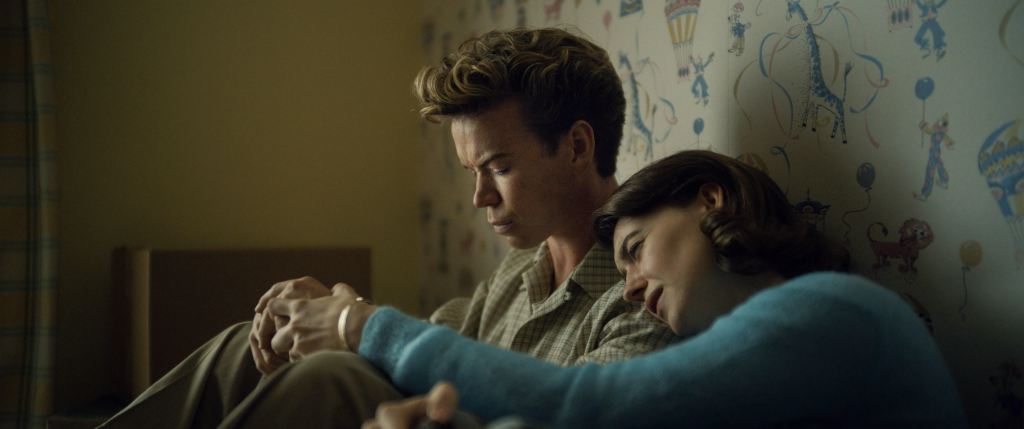
So, while there is no doubt that On Swift Horses fails to justify its adaptation on an artistic level, it’s not without its merit as a film. I do believe a lot of potential was left on the table with this cast and story, providing yet another cautionary tale of the hazards of adapting a story into a film. And, while those purists I mentioned earlier insist that “going in blind” is the best way to do it, it did not stop me from quickly identifying On Swift Horses as an adaptation of a romance novel… and a poor one at that.
My Score: 3.9 out of 10
Thanks for reading!

 POPCORN FOR BREAKFAST
Leave a comment