

Movie: A House of Dynamite (2025)
Production Companies: First Light, Prologue Entertainment, Kingsgate Films
Distributed by: Netflix
Producer(s): Kathryn Bigelow, Greg Shapiro, and Noah Oppenheim
Directed by: Kathryn Bigelow
Written by: Noah Oppenheim
Starring: Idris Elba, Rebecca Ferguson, Gabriel Basso, Jared Harris, Tracy Letts, Anthony Ramos, Moses Ingram, Jonah Hauer-King, Greta Lee, and Jason Clarke
Review by: Cam Wiggs
Have you ever heard of a “high concept” movie? It’s a term I started hearing shortly after I began getting serious about reviewing movies. At first, if I encountered the term in a conversation, a podcast, or a written review, I would simply smile and nod as if it was some snobby film term I felt should know but didn’t. Eventually, curiosity got the better of me and I realized “high concept” is not a snobby film term but actually a very helpful spectrum to use when classifying movies.
A high concept movie is one whose plot can be easily explained with a succinct, one-line description (think I Am Legend or Captain Phillips). As you might expect, a low concept film is exactly the opposite: a film that is not particularly plot driven and tends to focus more intently on characters (think Patterson or Inside Llewyn Davis). Any narrative movie falls somewhere on this high-to-low concept spectrum.
Perhaps the most important thing to know about these definitions and this spectrum as it relates to movies is this: to studio executives, high concept movies equal dollar signs. Think about it, these films sell themselves. You don’t even need to know the cast or who is directing; a good high concept movie hooks you on the premise alone. As you can imagine, having a premise that powerful is a huge advantage for any film, director, actor, or studio.
Kathryn Bigelow’s new movie, A House of Dynamite, is the textbook example of a high concept movie. Its premise? “A nuclear weapon launched by an unknown enemy is headed toward the United States, there are 18 minutes until impact.” I mean, sign me up. I got goosebumps just typing that line and I have already seen the movie! It’s an excellent concept. Add in a massive cast full of well-regarded actors (Rebecca Ferguson, Idris Elba, Jared Harris, etc.) and a director as critically-successful as anyone on a per film basis and, on paper, Netflix has a surefire hit on its hands.
In the first act, A House of Dynamite resoundingly delivers on that promising premise. There is so much to like. For starters, the character setups are charming and intimate without feeling too over-the-top. Then, there’s the scale of the film, which is tremendous and immediately felt. Bigelow accomplishes this scale in a number of ways including use of text on screen, a pounding, minimalist score from Volker Bertelmann (All Quiet on the Western Front (2022)), and a sharp dynamic contrast between physical locations achieved with beautiful establishing shots and intentional color grading. Finally, the cast, anchored in the first act by Rebecca Ferguson, Jason Clarke, and Anthony Ramos, delivers in spades with deeply genuine performances. Bigelow and company quickly establish a high-water mark against which any film would struggle to stack up… including, as it turns out, this very film in its final two acts.

Yes, the trouble starts to set in for A House of Dynamite in Act Two. Act One ends abruptly as the audience is hit with a heel turn in the form of a perspective shift. To be clear, perspective shifts can be effective narrative tools, as we saw earlier this year in Zach Cregger’s Weapons and, I think I understand the idea behind employing the technique in a movie like this. Used correctly, a perspective shift can help heighten the stakes of an apocalyptic disaster film like this, as the broadened scope invites the audience to think of the threat from more angles they may not have otherwise considered. In A House of Dynamite, however, I found the change in perspective to have almost the exact opposite effect.
As more characters and context were added, the weight of the story was not increased but instead diluted, each addition acting as another block in a tower, slowly weakening the structural integrity until even the strongest of bases could not support it. Every new character seems to have less and less care devoted to their introduction to the audience while well-established characters are abruptly removed from the story without any sense of closure.

The film also loses its sense of forward momentum, which is perhaps its biggest sin. Understandably, it can be difficult to turn an 18-minute, real-time (albeit fictional) incident into a 2-hour film, but violently shifting the story back and forth along that timeline and adding additional perspectives along the way is not the answer. Many films over the years with similar real-time stories have successfully accomplished telling the story in a thoughtful way without sacrificing forward momentum.
By the time A House of Dynamite enters the third act, the fuse that was lit at the beginning and burned brightly through the first third of the film has effectively burned out. It fails to introduce any new points of consideration or invite any additional introspection. It sort of slowly meanders to a largely unsatisfying conclusion. Sure, the movie is appropriately bleak and thought-provoking at times. Maybe, in a pre-Oppenheimer (2023) world, it would even be considered an innovative critique of nuclear warfare. In the year of 2025 and in this format, however, it is hardly more than a promising concept that fails to reach its full potential.

I think a lot of these failures can be attributed to an over-reliance on the superb premise. There is almost a sense of hubris in the movie or, at the very least, as sense of under-thinking the story. I am envisioning a subconscious thought process that goes something like “since the premise does sell itself, let’s just lean into it.” I cannot help but feel there simply was not enough thought about where to take the premise and how to land the story in a place that would achieve, pardon the terrible pun, maximum impact.
Thankfully, there are a few constants that keep the movie interesting enough to watch through til the end. The scale of the film remains in tact the entire time. For someone like me, scale alone can make any movie worth a watch. Seeing inside the White House Situation Room and various military installments around the country is enough to keep me engaged throughout the film, particularly since I was expecting something closer to a chamber piece based on the premise. Scale is something Kathryn Bigelow has excelled at conveying in her films throughout her career and she does so in expert fashion here.
The other constant is the cast. While the writing and characters aren’t always full-fledged, the acting remains solid. Beyond the three I mentioned earlier, nearly every significant actor in this film does their job and improves the impact of the film as a result.
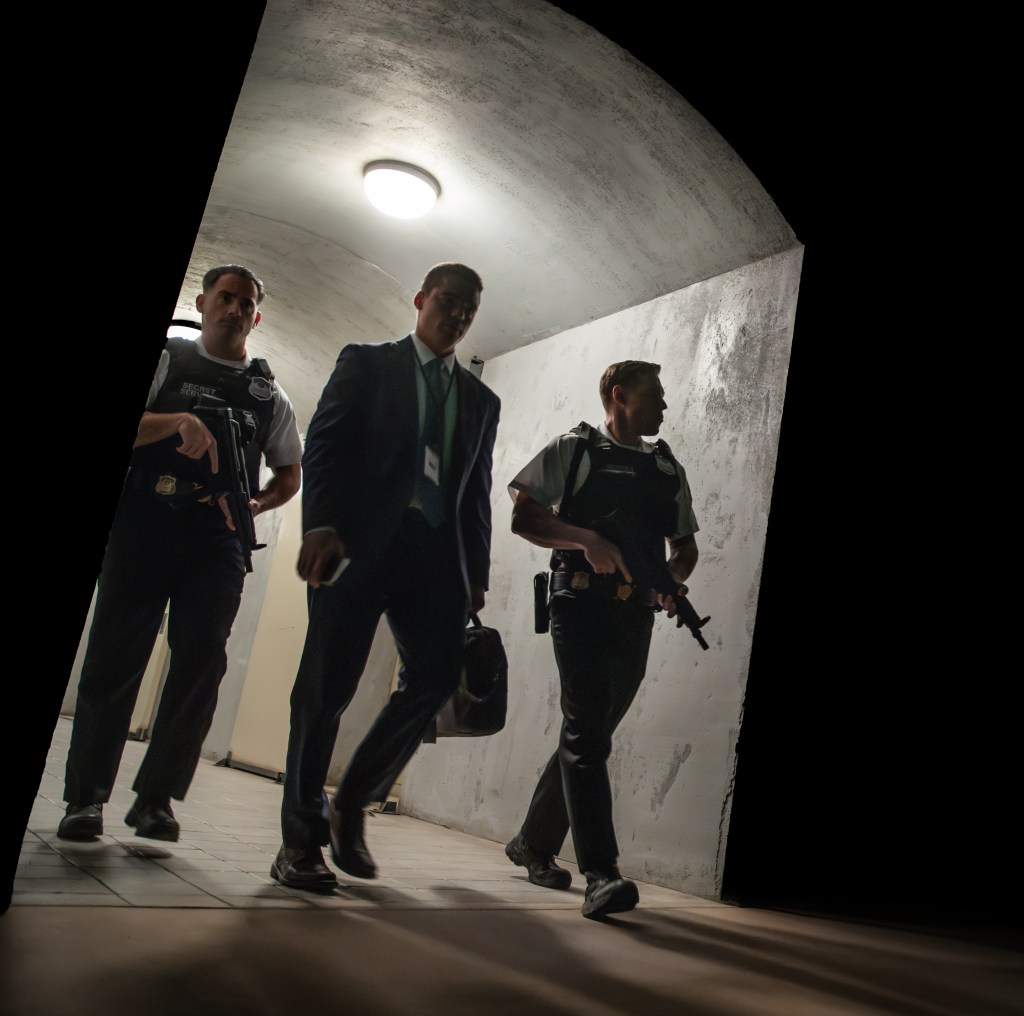
All told, A House of Dynamite, the textbook example of a high concept film, also manages to be a textbook example of a mixed bag. I can’t help but lament the missed opportunities here but to dwell too much on them would risk failing to give credit to the aspects of the film that really work. I expect many will watch this film and feel it deserves recognition for its premise and execution. For my part, I can’t help but feel there is a better approach to this story that we’ll never get to see.
Remember how I mentioned that a good high concept premise can be an advantage to a filmmaker? A House of Dynamite exhibits how it can simultaneously act as a disadvantage.
6.1/10
By: Cam Wiggs



 POPCORN FOR BREAKFAST
Leave a comment