
Movie: Mercy (2026)
Production Companies: Metro-Goldwyn-Mayer, Atlas Entertainment, Bazelevs Company
Distributed by: Amazon MGM Studios
Producer(s): Charles Roven, Robert Amidon, Timur Bekmambetov, Majd Nassif
Directed by: Timur Bekmambetov
Written by: Marco van Belle
Starring: Chris Pratt, Rebecca Ferguson, Kali Reis, Annabelle Wallis, Chris Sullivan, Kylie Rogers, Kenneth Choi
Review by: Cam Wiggs
It’s safe to say Chris Pratt is one of the most polarizing actors in Hollywood. After becoming a breakout star as the lovable oaf Andy Dwyer in NBC’s 2009 TV series “Parks & Recreation”, Pratt rocketed to super stardom after a surprising turn as a leading man in Marvel Studios’ Guardians of the Galaxy (2014). Add to résumé a series of interesting, understated roles in both Spike Jonze’s Her (2013) and Bennett Miller’s Moneyball (2011), as well as a couple of other franchise-helming roles in Jurassic World and The Lego Movie, and Chris Pratt’s career quickly became among the most enviable in the entire industry.
From there, however, things have gotten… interesting. Today, Chris Pratt is better known as an actor who churns out projects in the dadcore sub-genre, which includes action and/or sci-fi entries, such as Prime Video’s The Tomorrow War and their “The Terminal List” series. And if you are still caught up on the term “dadcore” and wondering what exactly it means, fear not! Chris Pratt’s latest film (the subject of my review today) provides a textbook example.
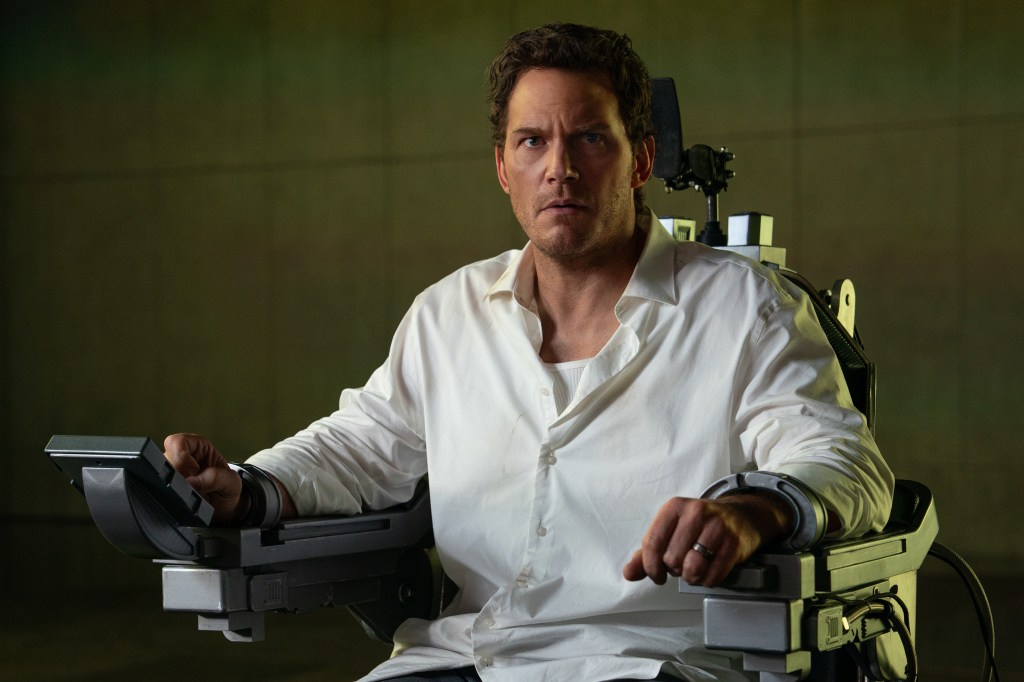
In Mercy (2026), Pratt stars as Chris Raven, an L.A.P.D. detective who recovers from an alcohol and head trauma-induced blackout to find himself restrained to a chair in an AI-powered courtroom, otherwise known as Mercy Court. The AI Judge, Judge Maddox (played by Rebecca Ferguson), informs Detective Raven that he has been charged with the murder of his wife with a 97.5% probability of guilt. Maddox tells Raven he is guilty until proven innocent and has ninety minutes to prove his innocence or face execution at the hands of the Mercy Court.
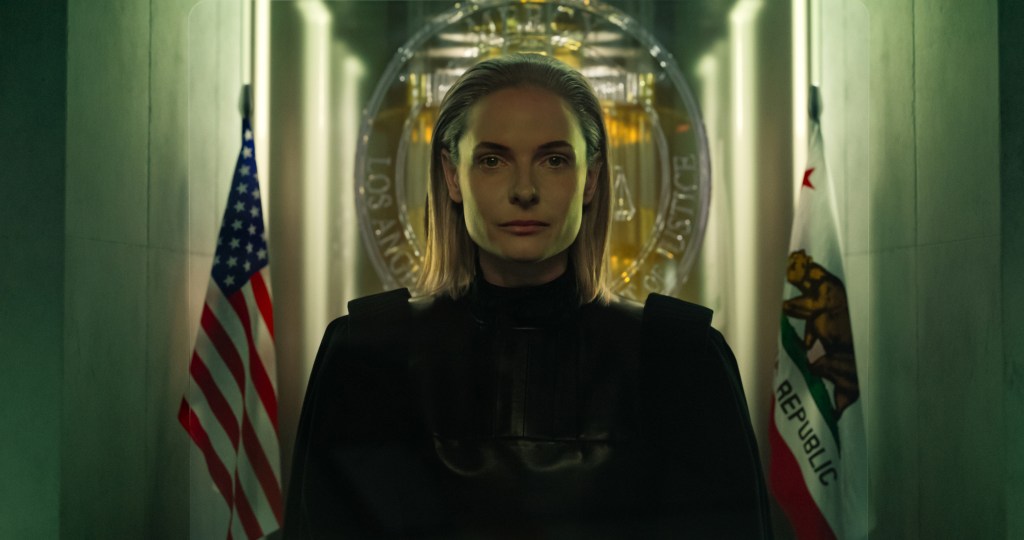
From my perspective, this is a fairly shaky foundation upon which to build a compelling story. Still, even if you find that premise interesting on paper, you’ll be dismayed to learn that the film falls apart almost immediately. The reason for the collapse is Mercy (2026) achieves complete and total failure in the most basic tenets of filmmaking and storytelling.
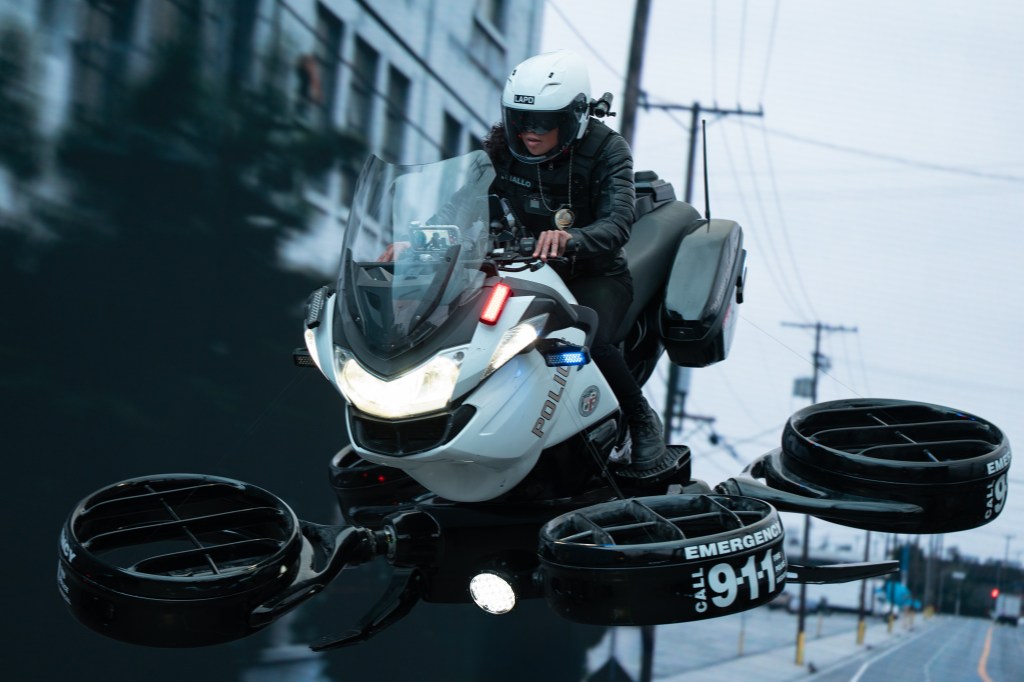
First, because I am a “story is everything” kind of person, let’s start with the story Marco van Belle and director Timur Bekmambetov are attempting to tell. A key aspect of storytelling in a sci-fi movie, particularly a sci-fi action thriller like this one, is world-building. Mercy (2026) takes place in 2029, a hilariously near-future year for us to believe one of the largest cities in the world turned its criminal justice system over to an AI and a police force of quad-copter riding cops. It simply doesn’t work. So why was the decision made? Production costs. 2029 is near enough to not have to worry about costuming, cell phones, architecture, vehicles, etc., but far enough, at least in this team’s view, to say “well, it’s the future, so anything goes.”
Another key aspect of the world-building and story is that the plot revolves around the AI Judge having access to every single photo, video, document, text message, etc. on any internet-connected device anywhere within its jurisdiction. Not only that, but it shares this access with the accused, in this case, Raven, to assist them in proving their innocence. And I know what you are thinking, “okay, that does sound like lazy writing,” but just wait, it gets worse. Not only is there an endless database of every piece of digital media from any device in L.A. County, but the “evidence” videos in this story don’t make sense. Some videos would never exist as they’re taken from camera angles that are, frankly, completely impossible and nonsensical.
Finally, outside of plot and world-building, the key component of a good story is good characters. Unfortunately, there are no good characters to be found. Every character in this movie is a horrible person. The characters aren’t just imperfect like everyone, as much as the writers would like you to believe so. They would be considered legitimately and objectively terrible to anyone with a moral compass.
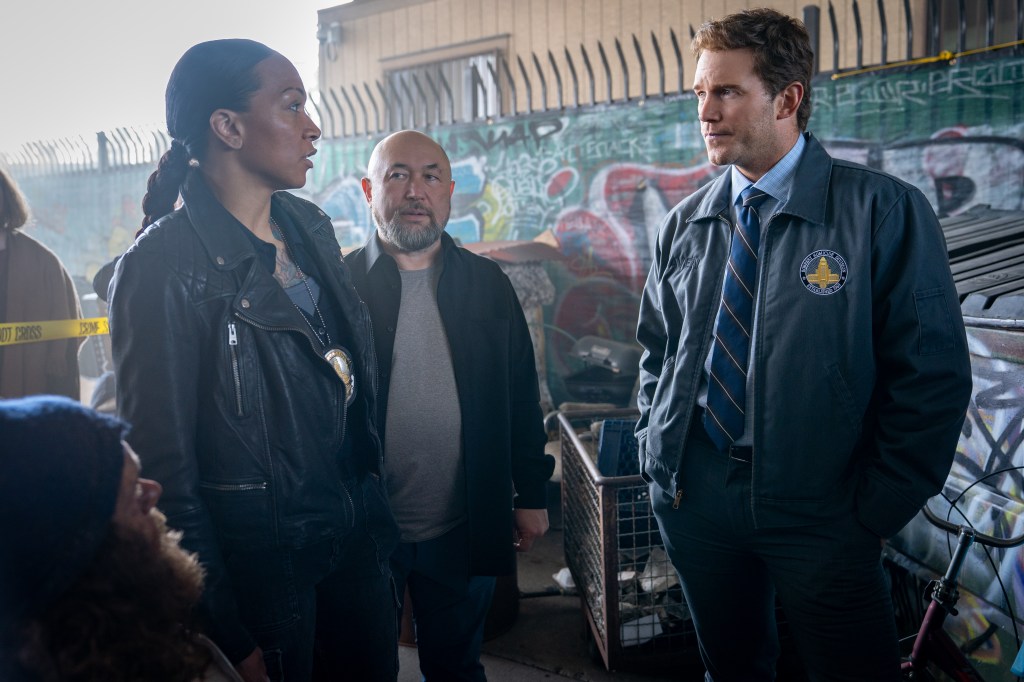
This brings us to the real people playing those characters. In addition to Chris Pratt and Rebecca Ferguson, Mercy (2026) has a surprising number of actors in the cast list given the somewhat chamber piece appearance portrayed in the trailer. The primary challenge facing each of these actors is that almost every scene involves the actor talking straight into a camera, rather than sharing dialogue with another person. The scenes where multiple actors are together sharing dialogue are mostly short, “evidence video” type scenes that don’t allow enough time for the actors to get into the scene and provide a dynamic performance.
Sure, you could make the argument that a lot of these choices were story-driven due to the candid-camera and FaceTime-esque videos that comprise the evidence, but the director chose to separate actors even when it wasn’t completely necessary. For example, I was shocked to find in the production notes that Pratt and Ferguson actually acted their scenes together. Based on the performances in the movie, I was certain they filmed each separately on different days to limit the amount of time each was on set and save money. So, if that wasn’t the case, why was it still bad? Well, even though both actors were on set together, delivering their lines to each other, they were in completely separate locations. Chris Pratt was in a large room surrounded by StageCraft’s “The Volume” screens, while Rebecca Ferguson was in a studio delivering her lines directly into a camera with her mic audio being fed to Chris Pratt and vice versa.
To me, if you have the luxury of having two high-profile actors on set at the same time, you need to build your production in such a way that they can act opposite each other for their shared scenes, which, by the way, comprise 90% of the movie, conservatively. I know there are technical limitations based on the use of The Volume, but to do otherwise is to do your film a tremendous disservice. These kinds of mind-boggling choices can only lead to the worst possible performance from each actor. It certainly led to a career-worst performance from Chris Pratt and a performance not up to Rebecca Ferguson’s usual standard as well.
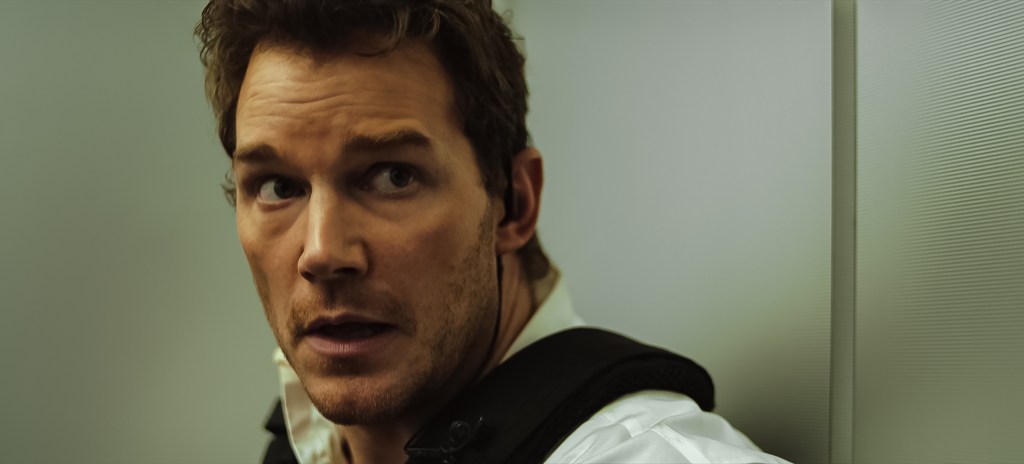
Beyond its impact on the acting performances, using The Volume also failed to enhance the visuals of the movie significantly. To clarify, this is not due to the technology itself but the way in which it was used. We know from past productions, most notably “The Mandalorian,” that The Volume can be used effectively. Sadly, in Mercy (2026), that was not the case. This movie is more than visually uninteresting; it is downright ugly. From fundamental aspects of the aesthetic like lighting, color grading, and vfx to goofy, almost parody-quality scenes involving The Volume screens trying to immerse Chris Pratt in a digital environment, none of it worked. In fact, many people in the audience laughed out loud due to the poor quality of the vfx in certain scenes.
In the end, this movie is written and directed like one of those rides at Universal Studios or Disney World that is based on a movie. It is another dizzyingly bad entry into the dadcore sub-genre and another head-scratching project choice from Chris Pratt, whose résumé is becoming harder and harder to defend.
1.5/10
By: Cam Wiggs

 POPCORN FOR BREAKFAST
Leave a comment