
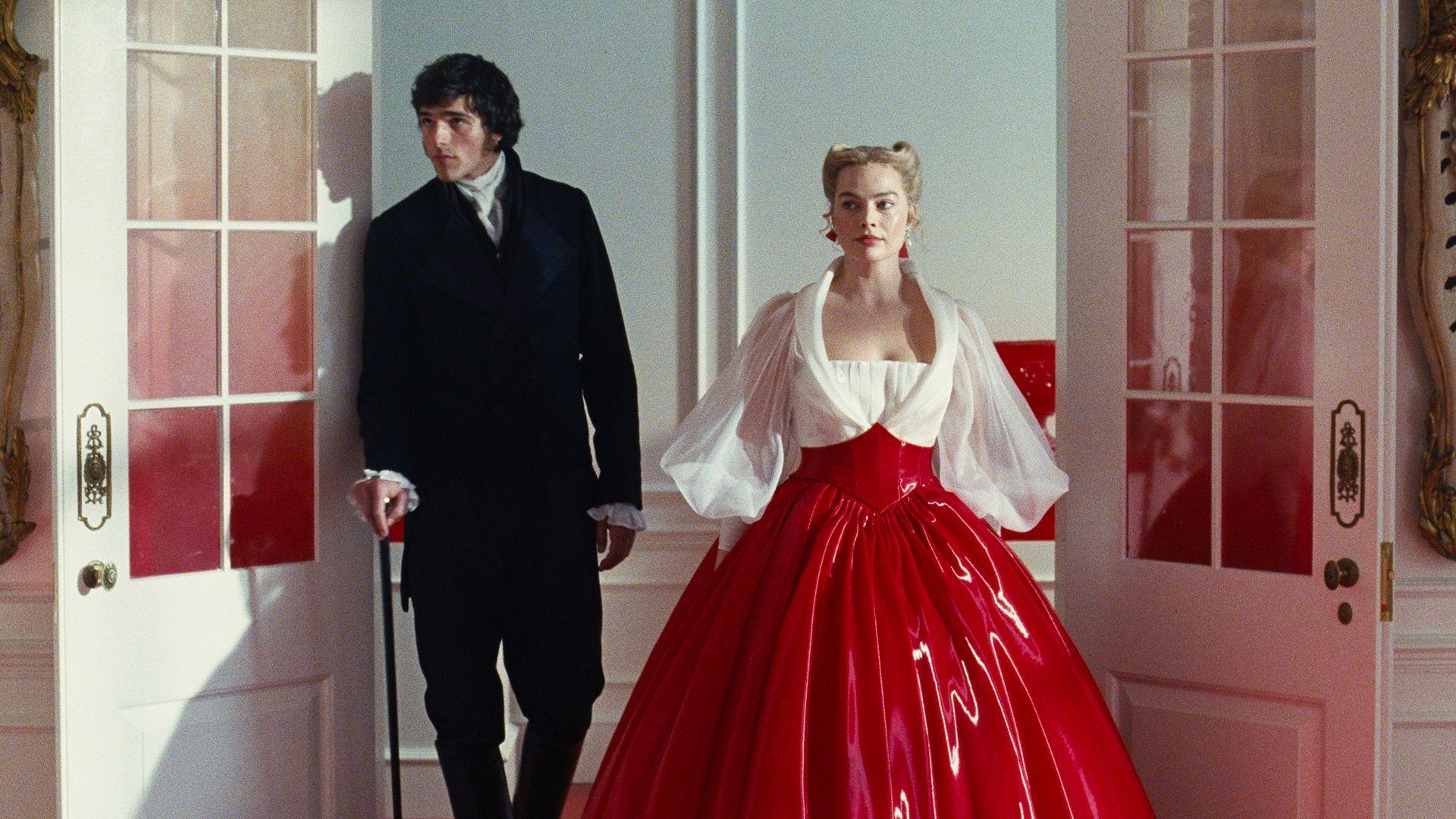
Another film adaptation of the famous Emily Brontë novel, Wuthering Heights, was not something many people were clamoring for. What would it take to break new ground on yet another version? Two things might work: something so outlandish that purists might hate, but cinemagoers would admire, or something so true to the source material that fans of the novel would finally have a canonical film version of the story. Emerald Fennell attempted the former. Was the filmmaker who included a bathwater drinking scene in a film with hopes for social media virality ever going to make a true-to-the-material version of Wuthering Heights? Absolutely not, and that’s okay. What’s not okay is that this supposedly “depraved” attempt at Wuthering Heights pulls back so many of its punches that it falls into lukewarm territory, and it’s hard to imagine any viewer in any camp feeling fully satisfied.
It’s best to examine a film just for the content on the screen, but with a marketing rollout like Wuthering Heights had, it’s impossible to ignore these outside forces. Fennell and team made it clear that her version of Wuthering Heights would have an element of sexual physicality between the two main characters, Heathcliff and Cathy, that Brontë’s novel didn’t have. The film’s two leads, Jacob Elordi and Margot Robbie, spent the entirety of their press tour gushing over each other to help build the sexual tension inside and outside of the film. We also cannot forget that the film was released on Valentine’s Day weekend. Why does this all matter? It matters because viewers are now being set up to expect something very specific.
In all of the clamoring that led up to this film’s release, Fennell failed to fulfill her promise for something so saucy and so different. Some expected story beats are touched on in very broad strokes, but the moments in between were meant to be filled with big swings and moments of awe. Nearly all of these moments feel timid and played down. With that being said, Fennell undoubtedly has a good eye, and most of Wuthering Heights looks great. The set design in the second half of the film is lovely, and some visual flourishes are intriguing. Although I appreciated much of the look of the film, she only scratched the surface of the potential surrealism she was hinting at. She toys with it, but it doesn’t go anywhere, leaving me more frustrated that she didn’t take it further than appreciative of what she did.
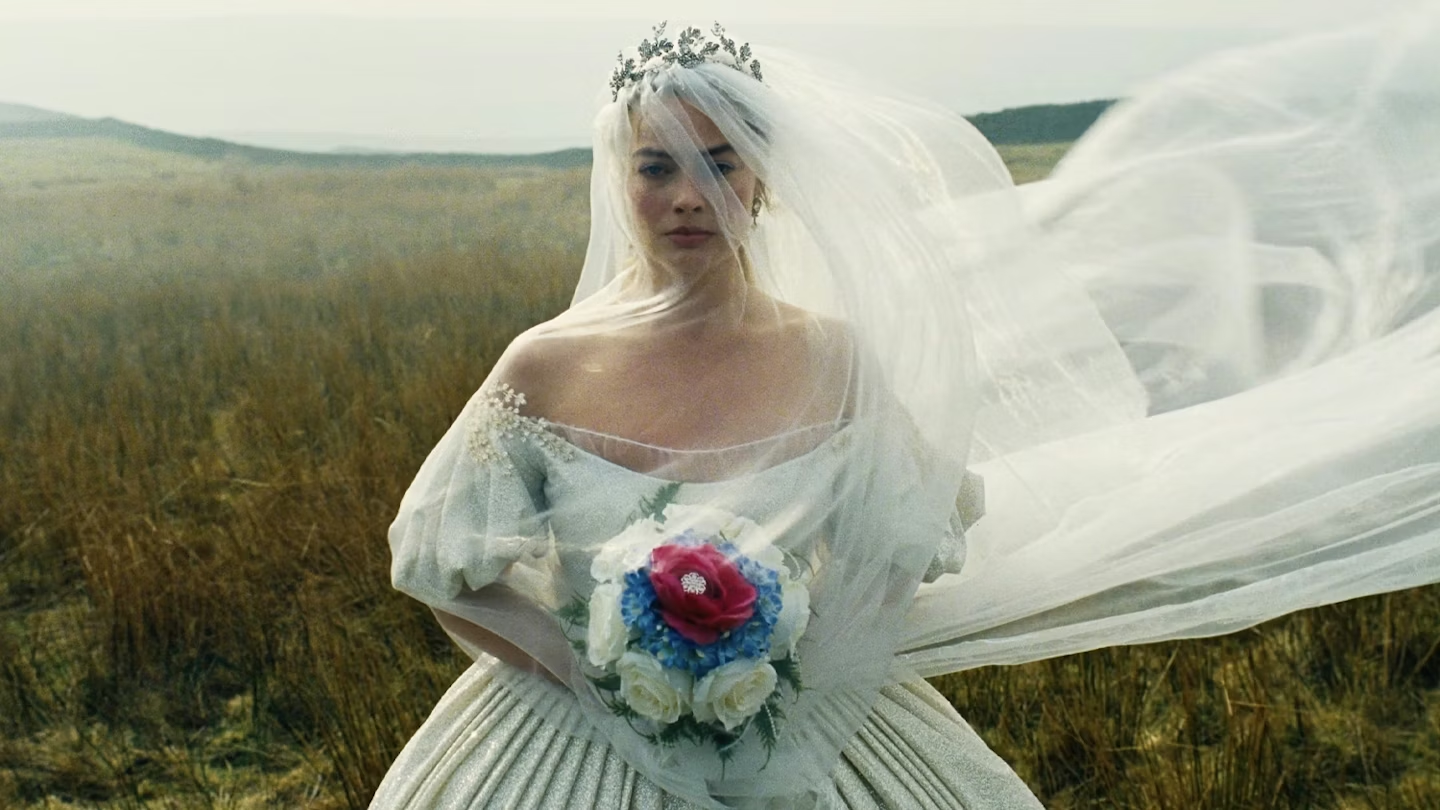
I know I made it clear that I’m more than okay with a film version of Wuthering Heights that isn’t entirely faithful to its source material, but when considering what’s left out and what’s altered, I grew uneasy. The casting of Jacob Elordi as Heathcliff and Margot Robbie as Cathy raised eyebrows upon announcement, mainly because of how much older they are than the characters in the novel. Casting older actors to play younger characters is common in film, and if we were to criticize this consistently, we’d have disdain for nearly every film ever made. What makes the castings so disappointing in this context is that 1) they are distracting, and 2) so much of the relationship intensity in the novel hinges on Heathcliff and Cathy feeling so passionate at such a young age.
Fennell doesn’t concern herself with talking about age in the film, and she thinks she gets away with it. The first 15 minutes of the film revolve around Heathcliff and Cathy meeting eachother at a young age, ages that are more representative of their actual ages in the novel. I think these are potentially the best minutes of Wuthering Heights because the dialogue and situations match the actors in a far more convincing way. A quick shoutout to Owen Copper and Charlotte Mellington, who are excellent in their roles as a young Heathcliff and a young Cathy.
Once the film jumps to Robbie and Elordi playing these same characters (a few years later, I think?), I was ripped out of the immersion. In this middle section of the film, when the characters are still at Wuthering Heights, Robbie really struggles with the material. These lines are meant for a young adult, and seeing them come out of Robbie’s mouth is off-putting. Not all of the blame can be put on Robbie’s shoulders, because Fennell’s adaptation of the dialogue could have been much sharper to allow her cast to represent age-appropriate versions of themselves. Why write and incorporate the dialogue of a 17-year-old when your character in the film isn’t literally playing a 17-year-old, but rather an ambiguous, slightly older age? Elordi struggles at times, too, but most of it has to do with his rigidity and slight accent slipping. We have two talented Australian actors on the screen; would it kill us to let them speak in their native accent? With all of the liberties Fennell takes, why not take this one?
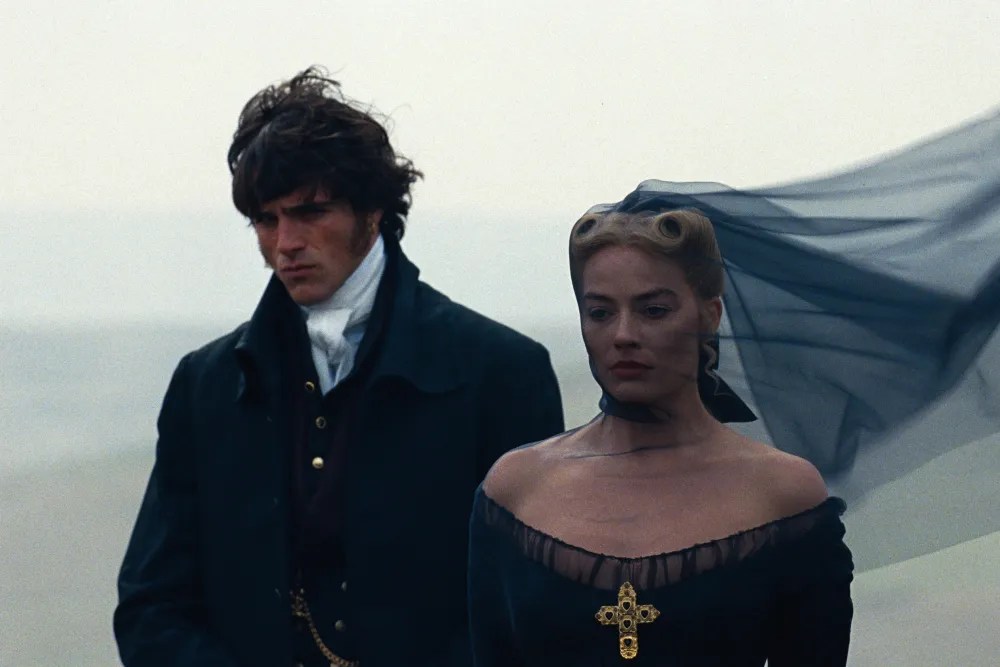
Much of my uneasiness also has to do with the questionable and uneven representation of Cathy, Heathcliff, and Isabella, played by the great Alison Oliver. Heathcliff and Cathy are both immensely complex and troubled characters in the novel. Cathy can be manipulative, she’s proud to a fault, but she’s also immensely likable and true to herself. Heathcliff is emotionally authentic and suffered abuse for much of his young life, which makes him incredibly sympathetic, but he is also deeply vengeful and abusive. Rather than giving us both sides of the coin for both characters, it felt like Fennell was more concerned with throwing most of the hardship and relationship issues on her version of the Cathy character. Much of Heathcliff’s vile behavior is explored in later portions of the novel that Fennell doesn’t concern herself with. To take it even further, the examples of Heathcliff’s abuse in the film feel downplayed and at times are played off as moments of levity. Sure, we see that he’s physically and emotionally abusing Isabella, but Fennell’s interpretation is that Isabella is “in on the abuse,” so it’s not that bad. For source material that is so emotionally complex, why does Fennell think it’s okay to play off two of her main female characters as simply the aggressor and the idiot?
I’m comfortable saying that as a whole, this isn’t a film made for me, but I wish that there was more there for me to appreciate. What I do appreciate is that there is some form of visual style, and it’s a visual style that might certainly stick with young moviegoers who are starting to discover their favorite cinema sensibilities. If Emerald Fennell’s films are becoming a jumping-off point for diving into other, better cinema, then I’m all for it.
Also, Charli XCX’s soundtrack is outstanding (but you’ll need to listen to it separately since it’s hardly used in the film).
5.2/10
Movie: Wuthering Heights (2026)
Production Companies: MRC, Lie Still, LuckyChap Entertainment
Distributed by: Warner Bros. Pictures
Producer(s): Emerald Fennell, Josey McNamara, Margot Robbie
Directed by: Emerald Fennell
Written by: Emerald Fennell (screenplay), Emily Brontë (novel)
Starring: Margot Robbie, Jacob Elordi, Hong Chau, Shazad Latif, Alison Oliver
Review by: Stefano Todaro
 POPCORN FOR BREAKFAST
Leave a comment